How to Plan an Advent Activity Calendar That Fits Your Real December
Last year a friend told me about day 9 of her advent calendar. It was 9:40 pm, the kids were asleep, and the envelope for the next morning was empty. She'd planned the first week in a burst of enthusiasm and then run out of steam. Day 9 became "watch TV together", and so did day 10.
Most advent calendars go wrong the same way. Nobody runs out of ideas. They plan one day at a time, in the evening, when they're tired.
Plan all 24 days in one sitting, around the December you actually have: busy nights get a 15-minute idea at home, free days get the outings, and the whole thing sits inside a small activity budget.
Here's the method, step by step, with one example family all the way through: the Riveras, with Mia (8) and Theo (5), a $120 budget for the month and a calendar that runs 1 to 24 December 2026.
1. Decide on 24 or 25 days
24 days runs from 1 December to Christmas Eve, which is what most families do. Pick 25 if you want a final card on Christmas morning. The Riveras went with 24 and made day 24 their Christmas Eve tradition: leave a snack out for Santa.
2. Set a budget for the activities, not the presents
This is the money for tickets, baking and craft bits. It keeps one excited Saturday from eating the whole month. The Riveras picked $120. That sounds like a lot until you price a cinema trip for four.
Then decide how many paid outings a week feels right. One is plenty for most families. It spreads the big things out and leaves room for cheap, cozy nights. If December is summer where you live, a park or beach picnic can take the place of skating.
3. Mark the busy days before you pick a single activity
This is the step people skip, and it's the one that saves December. Get the school calendar and your work diary and mark every night that's already full. Then mark any days away.
| Day | What's on | Type |
|---|---|---|
| Thu 3 Dec | School concert, 6 pm | Busy |
| Wed 9 Dec | Late work night | Busy |
| Fri 11 Dec | Swimming lessons | Busy |
| Wed 16 Dec | Office party (sitter) | Busy |
| Fri 18 Dec | Last day of school | Busy |
| Sun 20 & Mon 21 Dec | At Grandma's | Away |
Weekends count as free days unless something's already booked. The Riveras ended up with 7 busy or away days, 7 free days and 10 normal ones.
4. Match the activity to the day
Now fill the days, but match each idea to its day type:
- Busy day: 20 minutes or less, at home. Draw a picture for someone, a joke night, hide the ornament.
- Normal day: up to an hour. Make Christmas cards, a bird feeder, candy cane science.
- Free day: an outing or a bigger project. Ice skating, carol singers, a museum.
- Away: things that work anywhere. Carols, a winter star walk, a bedtime story.
On the concert night the Riveras do "draw a picture for someone": 15 minutes, free, done before the coats go on. Ice skating ($30) lands on Sunday the 13th, when nobody's rushing.
5. Mix in plenty of free days
Kids remember the time you spent together. They don't remember what it cost. Paper snowflakes, a kitchen dance party and a family show cost nothing and get talked about for weeks. The Riveras have 13 free days out of 24.
6. Check the spend week by week
Add up each week and make sure no single week blows the budget. Here's the Riveras' month:
| Week | Days | Spend |
|---|---|---|
| Week 1 | 1-5 Dec | $19 |
| Week 2 | 6-12 Dec | $43 |
| Week 3 | 13-19 Dec | $33 |
| Week 4 | 20-24 Dec | $2 |
| Total | $97 of $120 |
That leaves $23 spare for the day someone says "can we go back to the market?"
7. Make one supplies list a week
Each Sunday, look at the next seven days and write down what they need: pinecones, card, sprinkles, a jar. Most of it is already in the cupboard. One quick list beats a panicked shop at 8 pm.
8. Print cards that cut evenly, then fill the envelopes
Write each day's activity on a card, one or two sentences, and tuck it into an envelope, bag or pocket with a number on it. If you print the cards, make them all the same size with crop marks so they cut cleanly. Fill everything on 30 November and hang it up. Then December mostly takes care of itself.
On each card, write the activity as a short headline and one line that tells a child exactly what happens: "Hot chocolate bar. Mugs out, toppings in little bowls, everyone builds their own." Add the weekday so the busy-night cards make sense, and leave the cost off. A number tag on the outside of each envelope means the kids can find the right one without help, and a wall calendar on the fridge stops the "what are we doing tomorrow?" questions.
Keep two spare cards in a drawer, too. Someone will get a cold, or it will pour with rain on ice-skating day. Swap in a blanket fort and a film, and move the outing to the next free weekend.
Mistakes to avoid
- Planning one day at a time, the night before.
- Putting a two-hour outing on a school-concert night.
- Spending half the budget in the first week.
- Writing "do something fun" on the card. Kids want the actual thing.
- Forgetting the days you're away from home.
- Making every day a big production. Small and cozy counts.
Want the planning done for you?
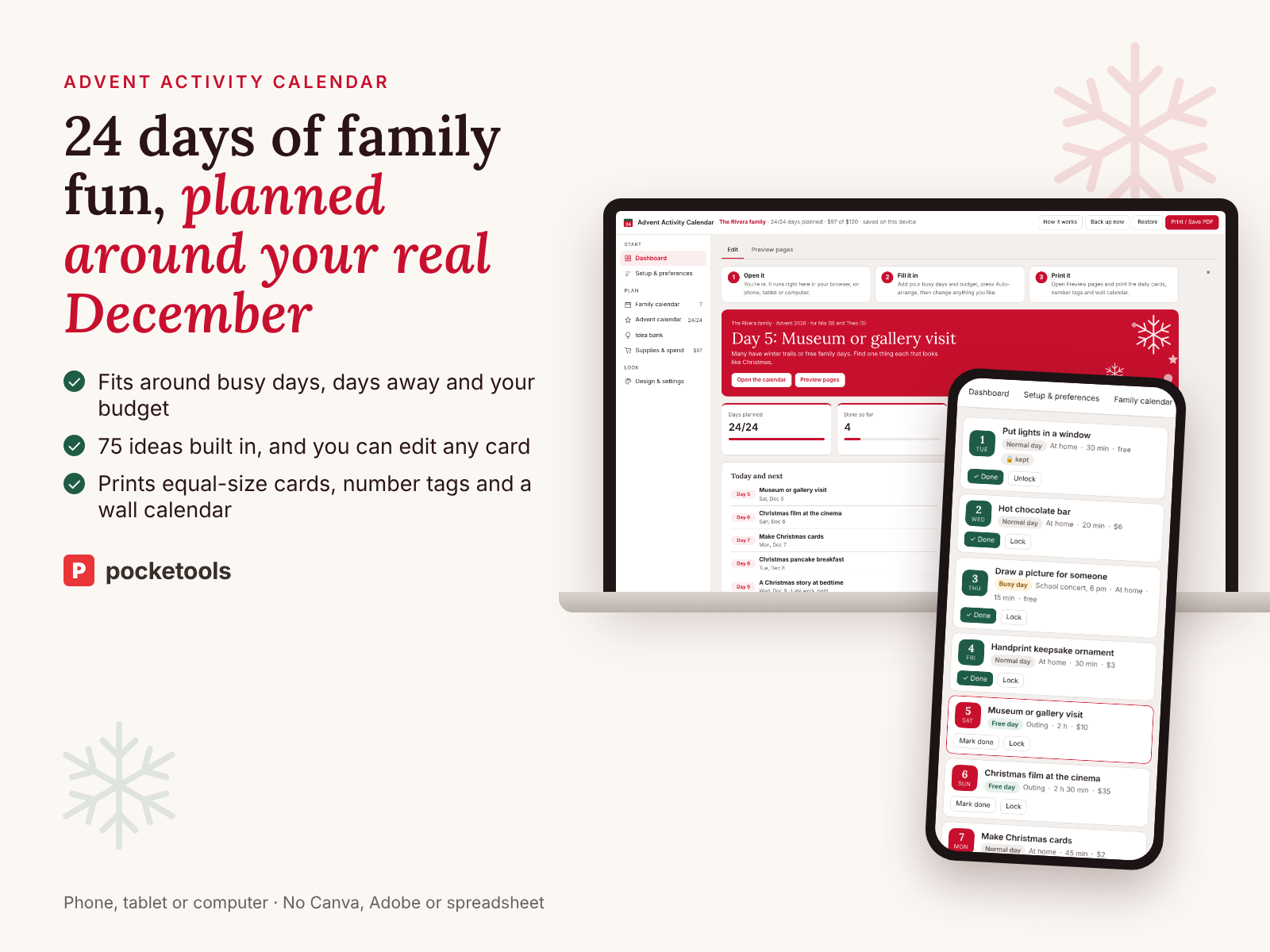
I built the Advent Activity Calendar to do steps 1 to 8 on your phone. Mark your busy days and your budget, press Auto-arrange, and it picks from 75 ideas to fit each day without going over budget. Change any word on any card, then print equal-size cards with crop marks, number tags and a wall calendar. $5.95, one time, no Canva.
See the Advent Activity CalendarQuestions people ask
When should I plan an advent activity calendar?
In mid to late November. That leaves time to mark busy days, buy a few supplies and print the cards before 1 December.
How much does an advent activity calendar cost?
As little as you like. More than half the days can be free. Our example family planned 24 days for $97 of a $120 budget, with 13 days that cost nothing.
What do you do on busy days?
Pick something that takes 20 minutes or less at home: a bedtime story, a joke night, hide the ornament, kind notes. Save outings for weekends.
Should it be 24 or 25 days?
24 days runs 1 to 24 December and ends on Christmas Eve. Choose 25 if you want a Christmas morning card too.
What if we're away for part of December?
Mark those days as away and choose ideas that work anywhere, like carols, a star walk or a story. Nothing needs packing.
Get the next free planner
One email when a new free tool or guide goes up. No spam.