Craft Fair Profit: How to Know What a Holiday Market Really Leaves You
It's 4 pm, the market is packing up, and the card reader says $1,272. It feels like a great day. Then the table fee comes to mind, and the fuel, and the wax and jars for everything that sold, and the lunch you bought because you couldn't leave the table. By the time you've thought it through, you're not sure if it was a great day or an average one.
Most makers find out in January, if they ever do. You can know before you book.
Take every fixed cost of the day, work out what one item really leaves you, divide one by the other to get your break-even, and after the market do the same sum with what really sold.
Here's that sum step by step, with one example the whole way through: a candle and soap maker at a one-day indoor holiday market, bringing 172 items across seven products.
1. Write down every fixed cost before you book
These are the costs you pay whether you sell one candle or a hundred. Put a number on each one, even the small ones.
| Cost | Example |
|---|---|
| Table fee | $85 |
| Application fee | $15 |
| Travel: 36 miles round trip at $0.70 a mile | $25.20 |
| Parking | $10 |
| Lunch and a display extra | $15 |
| Fixed costs for the day | $150.20 |
$0.70 a mile is close to the US business mileage rate and covers fuel and wear on the car. Use your own figure, in miles or kilometres. If the market also takes a percentage of sales, note it separately: it grows with your sales, so it isn't a fixed cost.
2. Work out what one item really leaves you
Price minus materials isn't the answer. Most shoppers pay by card, and the reader takes a cut of each payment. In the example the rate is 2.6% plus $0.15 per payment. Check yours.
| Product | Price | Materials | Card fee | Left |
|---|---|---|---|---|
| 8 oz soy candle | $18 | $5.40 | about $0.57 | about $12 |
| Goat milk soap | $7 | $1.60 | about $0.28 | about $5.10 |
| Holiday gift set | $38 | $11.80 | about $1.09 | about $25 |
The card fee per item assumes about 1.5 items per sale, so the $0.15 is shared. Your time isn't in this table yet. It comes back in step 8.
3. Find the break-even
Across everything this maker expects to sell, each item leaves about $8.67 on average after materials and card fees. Divide the fixed costs by that:
$150.20 ÷ $8.67 ≈ 17.3, so about 18 items, or roughly $222 in sales. Until the 18th sale, the day hasn't paid the maker anything.
This is the number to check before you book. A $40 farmers market pop-up and a $250 two-night market can both be good, but they need very different crowds.
4. Decide what to bring and how much you'll sell
Bring more than you expect to sell. A table with three candles left looks picked over, and shoppers walk past it. The example maker brings 172 items and expects to sell 60% of them: 103 items.
| Product | Bring | Expect to sell (60%) |
|---|---|---|
| Soy candles | 30 | 18 |
| Travel tins | 30 | 18 |
| Wax melts | 30 | 18 |
| Reed diffusers | 10 | 6 |
| Soap bars | 36 | 22 |
| Gift sets | 12 | 7 |
| Ornament candles | 24 | 14 |
Your first market of the season is a guess. After that, use what really sold at the last one.
5. Make to a list, not to a feeling
Compare what you're bringing with what's on the shelf. The maker has 24 candles and plans to bring 30, so 6 need making before this market. If there's a second market two weeks later, count what you'll probably sell at the first one too: that's where the night-before panic comes from. In the example, the second market needs 24 more candles on top of those 6.
6. Pack for the table, not just the stock
The things that go missing are rarely the products. Pack a table cover, risers, your sign, price tags and a price list, lights and an extension lead, a charged card reader and power bank, a cash float in small notes (this maker takes $120), bags, a chair, tape and scissors. Outdoors, add a tent and weights.
7. Count what sells on the day
A tally sheet on the table, one box per item sold, takes a second per sale and saves guessing at pack-up. Note the number of card payments from your reader, and any discounts you gave.
8. Do the real profit sum afterwards
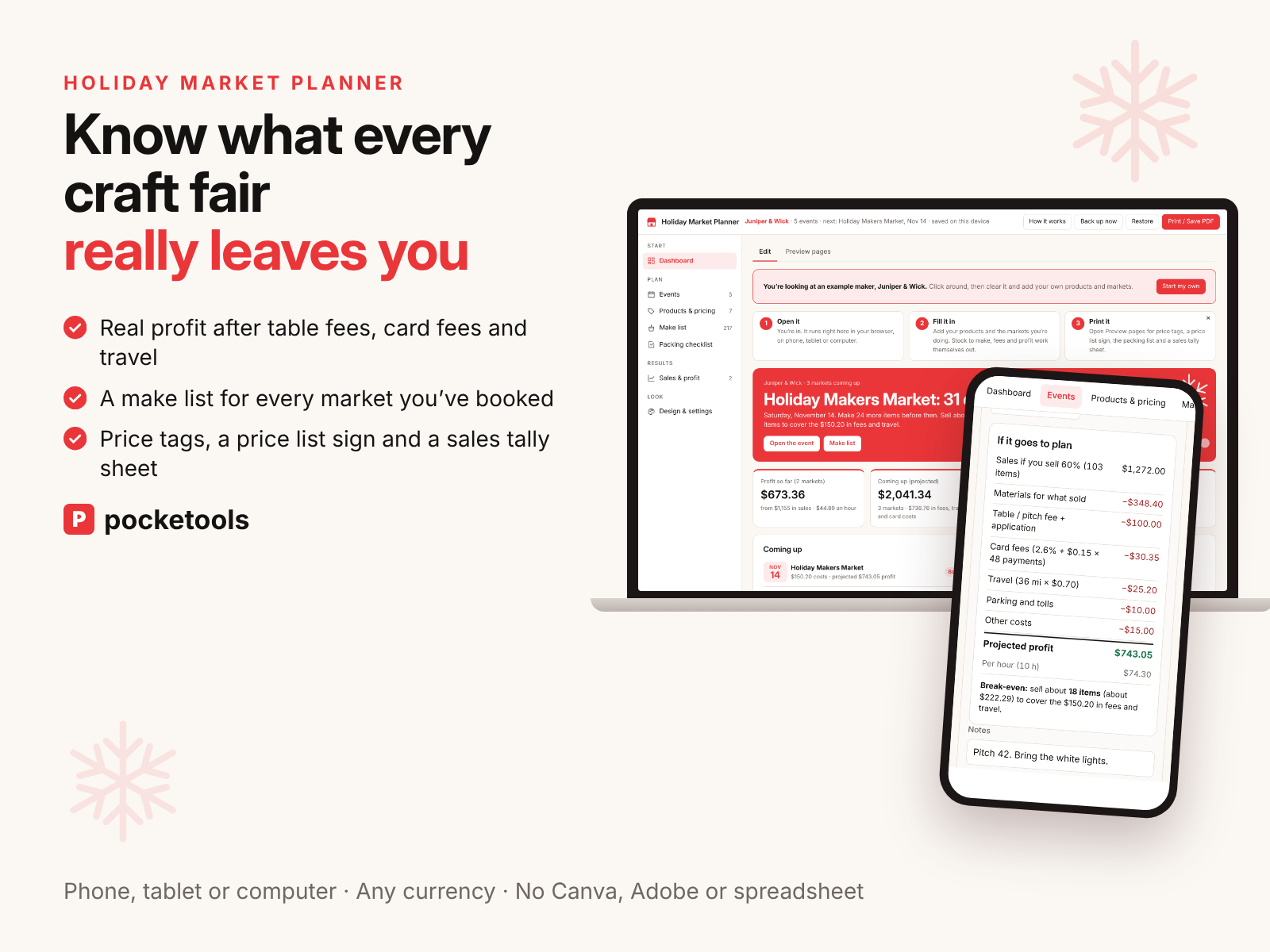
If the day goes to plan, the sum looks like this:
| Line | Amount |
|---|---|
| Sales: 103 items | $1,272.00 |
| Materials for what sold | −$348.40 |
| Table and application fee | −$100.00 |
| Card fees (2.6% + $0.15 × 48 payments) | −$30.35 |
| Travel, parking, lunch | −$50.20 |
| Profit | $743.05 |
That's $74.30 an hour for 10 hours at the market. But those 103 items took about 16 hours to make. Over 26 hours, it's about $28 an hour. That's the number to price for, and the one to compare between markets.
Mistakes to avoid
- Counting materials for everything you made instead of what sold.
- Forgetting card fees because they come out before the money lands.
- Leaving travel and parking out of the price.
- Booking a big-fee market without checking the break-even first.
- Making stock the night before because nobody counted what the first market would use up.
- Judging a market on sales, not on profit per hour.
Want this done for every market?
I built the Holiday Market Planner to do steps 1 to 8 for each market you book. It shows the real profit after every fee and the break-even before you go, makes a list of what to make before each market, and prints price tags, a price list sign, a packing list and a sales tally sheet. $12, one time, any currency, miles or km, no spreadsheet.
See the Holiday Market PlannerQuestions people ask
How much should I charge at a craft fair?
Enough to cover materials, card fees, your share of the table fee and travel, and your own time, with profit left over. Work out each cost per item, then set a price that leaves the margin you want, and round up to a tidy number.
Are craft fairs worth it?
A fair is worth it when your expected profit beats the time it takes. Before you book, divide the fixed costs (table, application, travel, parking) by what one item leaves you. If you can't sell that many, skip it.
How much stock should I bring to a craft fair?
More than you expect to sell, so the table looks full until the end. Many makers bring enough to sell about half to two-thirds. Track what sold at each fair and adjust for the next one.
Do I need a card reader at a holiday market?
Most shoppers expect to pay by card, so yes. Count its fee in your prices: typically a small percentage of each sale plus a few cents per payment. Check your own reader's rate.
What should I take to a craft fair?
Table cover, risers, a sign, price tags and a price list, lights, a charged card reader, a cash float in small notes, bags, a folding table and chair, tent weights if outdoors, tape and scissors, water and warm layers.
Get the next free tool for makers
One email when a new free tool or guide goes up. No spam.