How to Plan a Christmas Game Night Your Family Will Actually Finish
Last Christmas, somebody suggested a quiz at about 8 pm. Twenty minutes later we were still scrolling for questions, two cousins had wandered off to watch something, and the only score anyone remembered was a disputed point about reindeer.
Game nights rarely fail because the games are bad. They fail because nobody planned the order, the teams were lopsided, and the host spent the night reading off a phone.
Plan a two-hour run of 6 to 8 short games, split the teams before anyone sits down, write a few questions about your own family, and put every game and every score in one place.
Here's how, with one example the whole way through: the Novak family, 8 players aged 8 to 74, starting at 7:00 pm on 26 December.
1. Pick a start time and a hard finish
Two hours is the sweet spot. Long enough for a proper winner, short enough that the 8-year-old is still awake for the prizes. The Novaks start at 7:00 pm and finish at 9:00 pm. Say the finish time out loud at the start; it stops the "one more round" creep.
2. Split the teams before anyone sits down
Do it on paper first. Spread the children out, then mix households, so siblings and couples play against each other.
| The Elves | The Reindeer |
|---|---|
| Ana (41), Grandma June (74), Aunt Priya (43), Maya (11) | Tom (48), Uncle Dev (45), Sam (16), Leo (8) |
Two teams of four. Each has one child under 12 and one teenager or grandparent who knows the old stuff. Give the teams names before the first question, and let them choose a colour. It sounds silly, but a team with a name tries harder than "you lot on the sofa".
3. Write 3 to 5 questions about your own family
This is the round people talk about afterwards. Turn a funny moment into a question and an answer:
- Who once put the turkey in the oven still in its wrapper? Uncle Dev
- Who always falls asleep before the Christmas film ends? Grandma June
- What did Leo call reindeer when he was three? "Rain-dears"
Add easy ones anyone can answer: who's the youngest player tonight, who's the oldest, how many people are playing. Keep it kind. The aim is laughing with someone, not at them.
4. Put the games in order
Start easy, build up, break in the middle, end loud. Here's the Novaks' two hours:
| Time | Game | Minutes |
|---|---|---|
| 7:00 pm | Quiz round 1 (easy) | 25 |
| 7:25 pm | Top Answers boards | 20 |
| 7:45 pm | 60-second challenges | 15 |
| 8:00 pm | Snack break | 15 |
| 8:15 pm | Who in the family… | 10 |
| 8:25 pm | Quiz round 2: about our family | 20 |
| 8:45 pm | Money pull | 10 |
| 8:55 pm | Scores and prizes | 5 |
That's 120 minutes on the dot. The family round comes after the break on purpose: everyone's back, fed, and ready to argue.
5. Run a quiz that kids can win too
Ten questions a round, read slowly, answers written down by each team. Mix the levels: a few Kids questions ("How many reindeer pull Santa's sleigh, not counting Rudolph?" Eight), a few Easy, and one or two Grown-up ("In Iceland, how many Yule Lads visit before Christmas?" Thirteen). Give the kids' answer to the kids. Ten points for each right answer keeps the maths simple.
6. Add a ranked-answers board and a few challenges
A ranked-answers board is the game everyone can play without knowing anything. Ask "Name something you hang on a Christmas tree", and teams guess the most common answers: baubles, lights, tinsel, a star. Three wrong guesses and the other team gets one guess to steal the points.
Then three 60-second challenges, one player per team. Stack 10 plastic cups into a pyramid and back. Unwrap a gift wearing oven mitts. Name a Christmas word for every letter from A to Z. Winner gets 20 points.
7. Keep one scoreboard everyone can see
Disputed scores end more game nights than bad questions. One person keeps score, in one place, out loud. The Novaks were at 52 to 54 at the snack break, which is exactly what you want: close enough that nobody gives up. If a team falls far behind, make the last game worth double.
Write each game's points down as soon as it ends, not at the end of the night. If somebody spots a mistake, fix the last entry and move on. A quick, visible correction keeps the peace far better than a long argument about who said "tinsel" first.
8. End with prizes, not a whimper
Finish on something everyone takes part in. A money pull works for mixed ages: fold small cards into a box, mostly $1 and $5 with one $20, and every player pulls one. The Novaks used 17 cards, $70 in all. Then a winner certificate for the top team, read out with their names, and you're done by 9:00 pm.
Mistakes to avoid
- Choosing games on the night while everyone waits.
- Letting one household form a team of experts.
- Rounds longer than 25 minutes.
- Questions only grown-ups can answer, or only one person in the family knows.
- Scores kept in three places, or not at all.
- No finish time, so the night fizzles out instead of ending on the prizes.
Want the whole night ready to play?
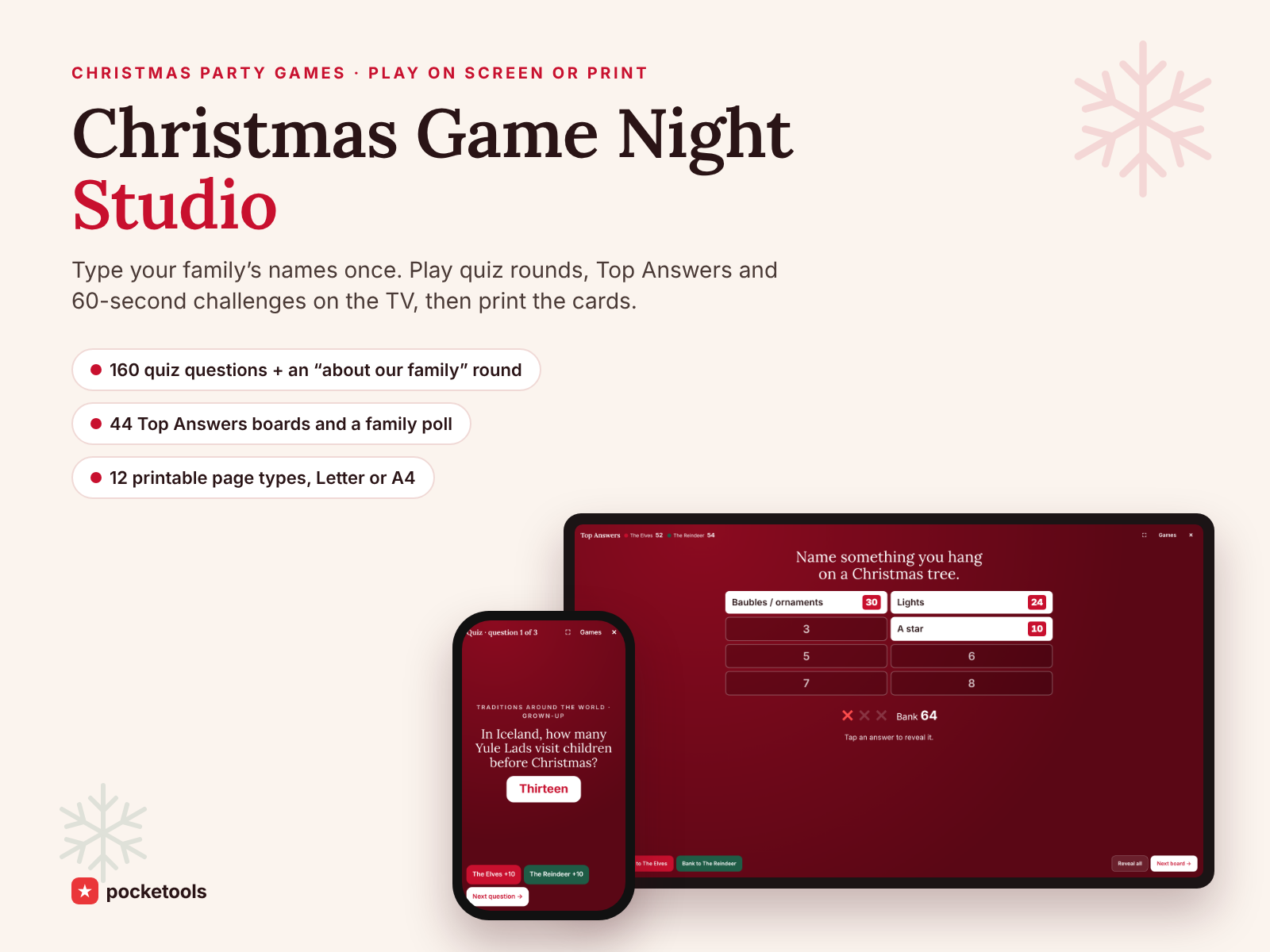
I built Christmas Game Night Studio to do steps 1 to 8 for you. Type your players and a few family facts once. Then play 160 quiz questions, 44 Top Answers boards and 32 challenges on your TV or phone, with the scores adding up as you go. It prints trivia cards with the answers on the back, team cards, a scorecard and certificates. $9.95, one time, no Canva.
See Christmas Game Night StudioQuestions people ask
How long should a family game night last?
About two hours, including a 15-minute snack break. Past that, the youngest players fade and the scores stop mattering. Plan 6 to 8 short games rather than 3 long ones.
What are good Christmas games for mixed ages?
Team games where kids and grown-ups play together: a quiz with an easy round, a ranked-answers board where everyone can guess, and 60-second challenges with cups, balloons and oven mitts. Spread the kids across the teams.
How do you split teams fairly?
Spread the children first, one or two per team, then the adults. Mix households so couples and siblings play against each other. Two to four teams of 3 to 5 people works best.
How many trivia questions do I need for a game night?
About 10 per round. Two rounds of 10 fill 45 minutes with marking and arguing. Keep one round about your own family; it's always the loudest.
What prizes work for a family game night?
Small and silly: a winner certificate, first pick of the dessert, the remote for the evening, or a money pull with a few $1 and $5 cards and one $20.
Get the next free planner
One email when a new free tool or guide goes up. No spam.