How to Price Handmade Soap: Your Real Cost per Bar, Step by Step
Picture a Saturday market in October. Your lavender bars are $8 each, and by two o'clock the basket is empty. It feels like the best day of the season. On the drive home you start adding it up: the oils, the essential oil, the boxes, the evening you spent making the batch. Somewhere around the lavender oil the number stops feeling so good.
Most soap makers price by looking at the table next to them. That's a fine way to check a price. It's a bad way to set one.
Price one whole batch, add your time, divide by the bars you can actually sell, add packaging and overheads, then multiply by a markup and check what's left after fees and at wholesale.
Here's that sum step by step, with one example all the way through: the Everyday Bar, a 12-bar batch from 32 oz of oils (olive, coconut, shea, sweet almond, cocoa butter and castor) with lavender essential oil and a little kaolin clay. Every price is an example. Use your own.
1. Price one whole batch of ingredients
Work out what each ingredient in the batch cost you, from the price and size of the pack you bought. Count the lye, the water, the fragrance and the clay, not just the oils.
| Ingredient | Used | Cost |
|---|---|---|
| Olive oil | 12.80 oz | $3.66 |
| Coconut oil 76° | 8.00 oz | $1.71 |
| Shea butter | 4.80 oz | $2.70 |
| Sweet almond oil | 3.20 oz | $1.50 |
| Cocoa butter | 1.60 oz | $1.60 |
| Castor oil | 1.60 oz | $0.60 |
| Lye (sodium hydroxide) | 4.44 oz | $2.22 |
| Distilled water | 9.02 oz | $0.11 |
| Lavender essential oil | 1.60 oz | $8.80 |
| Kaolin clay | 0.50 oz | $0.25 |
| Ingredients for the batch | $23.15 |
Look at the lavender. It costs more than the olive, coconut and shea put together. Keep that in mind for step 6.
The lye here (4.44 oz at 5% superfat and 33% lye concentration) comes from the recipe. Always double-check lye amounts with a second lye calculator before your first batch. Wear goggles and gloves.
2. Add your time
Weighing, mixing, pouring, cutting and cleaning up all count. Pick an hourly rate you'd accept from someone else, and use it every time.
| Time | Example |
|---|---|
| Making time per batch | 90 min |
| Hourly rate | $18 |
| Your time for the batch | $27.00 |
If you leave your time out, the price only works for as long as you're happy to work for free.
3. Count the bars you can actually sell
A loaf cut into 12 bars rarely gives you 12 bars to sell. There are end pieces, a wonky cut, a bar you keep to test. In the example, 11 of the 12 bars go on the table. Divide by 11, not 12. One lost bar adds about 40 cents to the cost of every other bar.
4. Add packaging and overheads per bar
These are small, so they get forgotten. Add them per bar.
| Per bar | Example |
|---|---|
| Kraft box | $0.44 |
| Overheads (power, printer ink, a share of moulds and fees) | $0.25 |
| Packaging and overheads | $0.69 |
5. Work out the cost per bar
| Line | Amount |
|---|---|
| Ingredients | $23.15 |
| Your time | $27.00 |
| Batch total | $50.15 |
| ÷ 11 bars you can sell | $4.56 |
| + packaging and overheads | $0.69 |
| Cost per bar | $5.25 |
That's the number every price decision starts from. Write it on the recipe.
6. Work out the cost for each scent
Same oils, same time, same box. Only the fragrance changes, and the cost changes with it.
| Scent | Per batch | Cost per bar |
|---|---|---|
| Lavender essential oil | $8.80 | $5.25 |
| Peppermint essential oil | $5.60 | $4.96 |
| Cedar & orange fragrance oil | $3.60 | $4.78 |
If all three sell at one price, work it out from the most expensive scent, or charge a little more for the pricey ones. Averaging them hides the bar that makes you the least.
7. Pick a markup, then see what you keep
A markup turns your cost into a shelf price. Many makers use somewhere between 2 and 4 times cost. At 3 times, $5.25 becomes $15.75, which you'd round to $16. That's a long way from $8.
Then take off the fee. Card readers and online shops take a percentage of each sale; the example uses 6.5%. Check your own.
| Price | Fee (6.5%) | You keep per bar |
|---|---|---|
| $7 | $0.45 | $1.30 |
| $8 | $0.52 | $2.23 |
| $12 | $0.78 | $5.97 |
| $16 (3×) | $1.04 | $9.71 |
At $8, the batch of 11 leaves $24.54 on top of the $27 for your time. Not terrible. But it leaves almost nothing for the next step.
8. Check wholesale before you say yes
A shop that stocks your soap will usually pay about half of your retail price. Do the check before they ask.
| Retail price | Wholesale (50%) | Per bar after cost |
|---|---|---|
| $8 | $4.00 | −$1.25 |
| $12 | $6.00 | $0.75 |
| $16 | $8.00 | $2.75 |
At $8 retail, every bar you sell wholesale loses $1.25. If wholesale is part of your plan, the retail price has to leave room for it, or the cost has to come down.
Mistakes to avoid
- Counting only the oils and forgetting lye, fragrance, clay and water.
- Leaving your own time out of the cost.
- Dividing by the bars you cut instead of the bars you can sell.
- Giving every scent the same cost when one essential oil can cost more than the main oils put together.
- Forgetting the card or shop fee because it comes off before the money lands.
- Agreeing to wholesale before checking half your price covers the bar.
- Copying the price on the next table without knowing your own cost.
Want this sum done for every recipe?
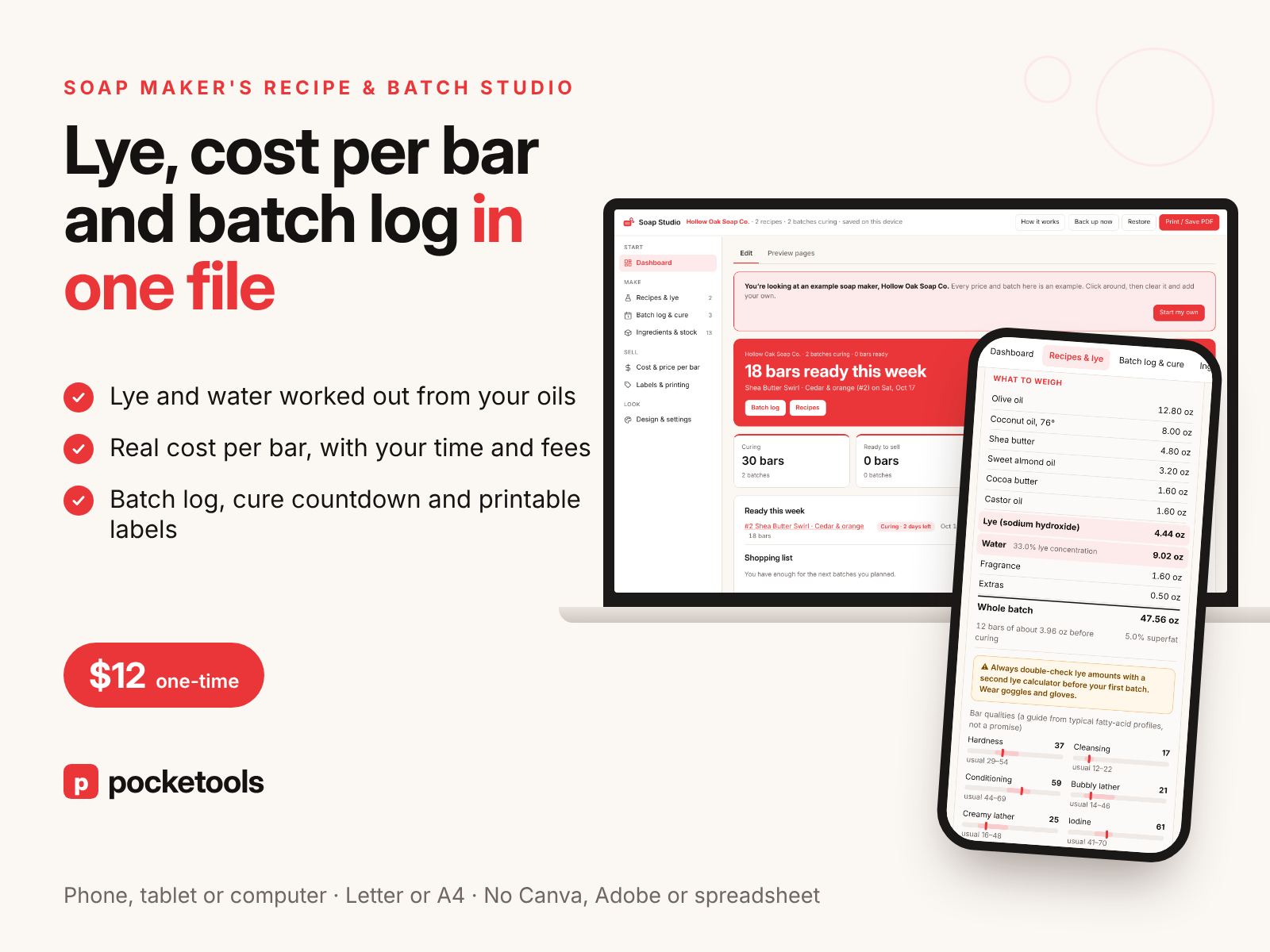
I built the Soap Maker's Recipe & Batch Studio to do steps 1 to 8 for each recipe and scent. It works out the lye and what to weigh from 48 oils, shows the cost per bar with your time counted, warns you when wholesale doesn't cover cost, logs batches with a cure countdown, keeps your stock, and prints labels, recipe cards and batch sheets. One file, $12, ounces or grams, no spreadsheet.
See the Soap StudioQuestions people ask
How much should I charge for a bar of handmade soap?
Start from your real cost per bar: ingredients, your time, packaging and overheads, divided by the bars you can actually sell. Multiply by a markup (many makers use 2 to 4 times cost), take off your shop or card fee, and check what is left. Then compare with what similar bars sell for where you sell.
How do I work out the cost of one bar of soap?
Add up the cost of every ingredient in one batch, add your making time at an hourly rate, and divide by the number of bars good enough to sell. Then add packaging and overheads per bar. In the worked example that is $23.15 plus $27, divided by 11 bars, plus $0.69: $5.25 a bar.
What markup should I use for handmade soap?
Many makers aim for 2 to 4 times their cost per bar, and about 3 times is common if you also sell wholesale. Whatever you pick, check that half of your retail price still covers your cost, or wholesale will lose money.
Should I sell my soap wholesale?
Only when the wholesale price, usually half of retail, is higher than your cost per bar. In the example, a bar that costs $5.25 and sells for $8 would lose $1.25 at $4 wholesale. Raise the retail price or lower the cost first.
How long should cold process soap cure before I sell it?
Many soap makers cure cold process bars for about four weeks before selling, and some recipes take longer. Write the pour date and the ready date on every batch so you never sell a bar too early.
A note on labels: label rules depend on where you sell and what you claim. In the US, true soap is regulated by the CPSC; soap that claims to moisturize or treat skin is a cosmetic or drug under the FDA. Check your local rules.
Get the next free tool for makers
One email when a new free tool or guide goes up. No spam.