How to Do a New Year Reset: Look Back, Set Goals and Plan January's Money
It's 20 January. The planner you bought on the 1st is in a drawer. Page one has twelve goals in your best handwriting. The habit tracker has nine ticks and then nothing. The budget page is blank, because it wanted you to do the sums yourself, and rent came out before you got round to it.
That isn't a willpower problem. The plan was too big, and it had no money in it.
Look back at the year, score the parts of your life, pick three goals from the biggest gaps, give each one a habit with a tired version, then plan January's money until every dollar has a job.
Here's that reset step by step, with one example all the way through: Sam, who has about $3,450 coming in each month, a credit card to clear and a vague wish to feel less tired. It takes one evening. Every number is an example. Use your own.
1. Look back before you look ahead
Give the old year 15 minutes before you plan the new one. Answer eight short prompts:
- My biggest wins
- What I'm proud of
- What was hard
- What I learned
- Best memories
- People I want to thank
- What I'm leaving behind
- What I'm keeping
The last two matter most. "Leaving behind" is where the goals start. "Keeping" stops you from throwing out the things that already work.
2. Score your life wheel
List eight areas: health and energy, money, work and study, home, family and friends, fun and adventure, growth and learning, rest and calm. Score each from 1 to 10 twice: where it is now, and where you'd like it to be by the end of the year.
Sam's average is 5.3 now and 7.6 as a goal. The biggest gaps:
| Area | Now | Goal | Gap |
|---|---|---|---|
| Rest and calm | 3 | 7 | 4 |
| Money | 4 | 8 | 4 |
| Health and energy | 5 | 8 | 3 |
Those three rows are where the goals go. Everything else can wait.
3. Pick one word for the year
A word of the year is a quick test for new plans in March. Sam's word is Steady. The why: "Fewer plans, kept better. Calm money, more energy, more time with people I love." When a new idea turns up, ask whether it fits the word. If not, it's a no for now.
4. Choose three goals, each with a first step
A goal without a first step stays a wish. For each one, write why it matters, how you'll know it's done, a done-by date and the very first thing you'll do. Sam has five goals on the list but stars only three:
| Goal | Done by | Very first step |
|---|---|---|
| Run a 10K | 13 June 2027 | Rejoin the running club on 6 Jan |
| Save a $3,000 emergency fund | 31 Dec 2027 | Set up a $200 transfer on payday |
| Phone off at 10 pm | 31 Mar 2027 | Charge the phone in the kitchen |
Add four checkpoints, one per quarter, so you look at each goal in April, July and October, not just next December.
5. Turn each goal into a habit with a tired version
Most habit trackers die on the first bad day. Plan for that day now. Give each habit a cue (when it happens), a target number of days a week, and a tired version: the smallest thing you'd still count.
| Habit | Cue | Tired version |
|---|---|---|
| Walk or run 20 minutes (5 days a week) | Straight after work | 10-minute walk round the block |
| Read 10 pages (every day) | Instead of scrolling at night | One page in bed |
| Phone off at 10 pm (5 days a week) | 10 pm alarm | Phone on the kitchen charger |
| Log today's spending (every day) | With evening tea | Just open the spending page |
A tired day still gets a tick. Track your streak, but watch the percentage of your target more. Four days out of five is a good week.
6. Plan January's money before it starts
Write down what comes in, then subtract everything that goes out. Bills first, with their due days. Then planned spending, savings and debt.
| January 2027 | Amount |
|---|---|
| Money in (salary $3,200 + tutoring $250) | $3,450.00 |
| Bills (rent $1,350 on the 1st, phone $45, internet $60, streaming $28, car insurance $110) | −$1,593.00 |
| Spending (groceries $420, eating out $120, transport $160, fun $100, personal $80, gifts $50) | −$930.00 |
| Savings (emergency fund $200, summer trip $171.43) | −$371.43 |
| Credit card ($60 minimum + $90 extra) | −$150.00 |
| Left to give a job | $405.57 |
That $405.57 isn't spare money. If it has no job, it drifts into takeaways and one-click buys. Give it one now: a buffer, more savings, or more on the card.
7. Give savings and debt a monthly number
A savings goal needs a monthly amount, not a hope. Take what's left to save and divide by the months you have.
| Savings goal | Target | Saved | Per month |
|---|---|---|---|
| Emergency fund, by 31 Dec | $3,000 | $600 | $200.00 (12 months) |
| Summer trip, by 31 Jul | $1,200 | $0 | $171.43 (7 months) |
Then the card: $2,400 at 22.9% APR. Paying the $60 minimum plus $90 extra clears it in about 20 months, with about $491.20 of interest. Minimum only would take about 57 months longer and cost about $1,683 more in interest. That's a rough monthly estimate, not advice, so check your own statement.
8. Do the small jobs, then set a weekly check-in
Finish with a reset checklist of small jobs you can tick off in the first weeks of January:
- Back up phone photos and clear the camera roll
- Review every subscription and cancel one
- Set up automatic savings on payday
- Check every bill's due date
- Declutter one drawer or shelf a day for a week
- Change one old password
Last, pick a weekly reset time, Sunday or Monday. Ten minutes: tick your habits, log what you spent and look at your top three goals. By 9 January Sam has spent $443.45 of the $930 spending plan, with 4 no-spend days.
Mistakes to avoid
- Setting twelve goals and working on all of them at once.
- Writing goals with no done-by date and no first step.
- Giving habits no tired version, so one bad day ends the streak.
- Planning goals but not money, then letting the first big bill knock the plan over.
- Leaving the money left over with no job.
- Paying only the minimum on a card without seeing what it costs.
- Never looking at the plan again until next December.
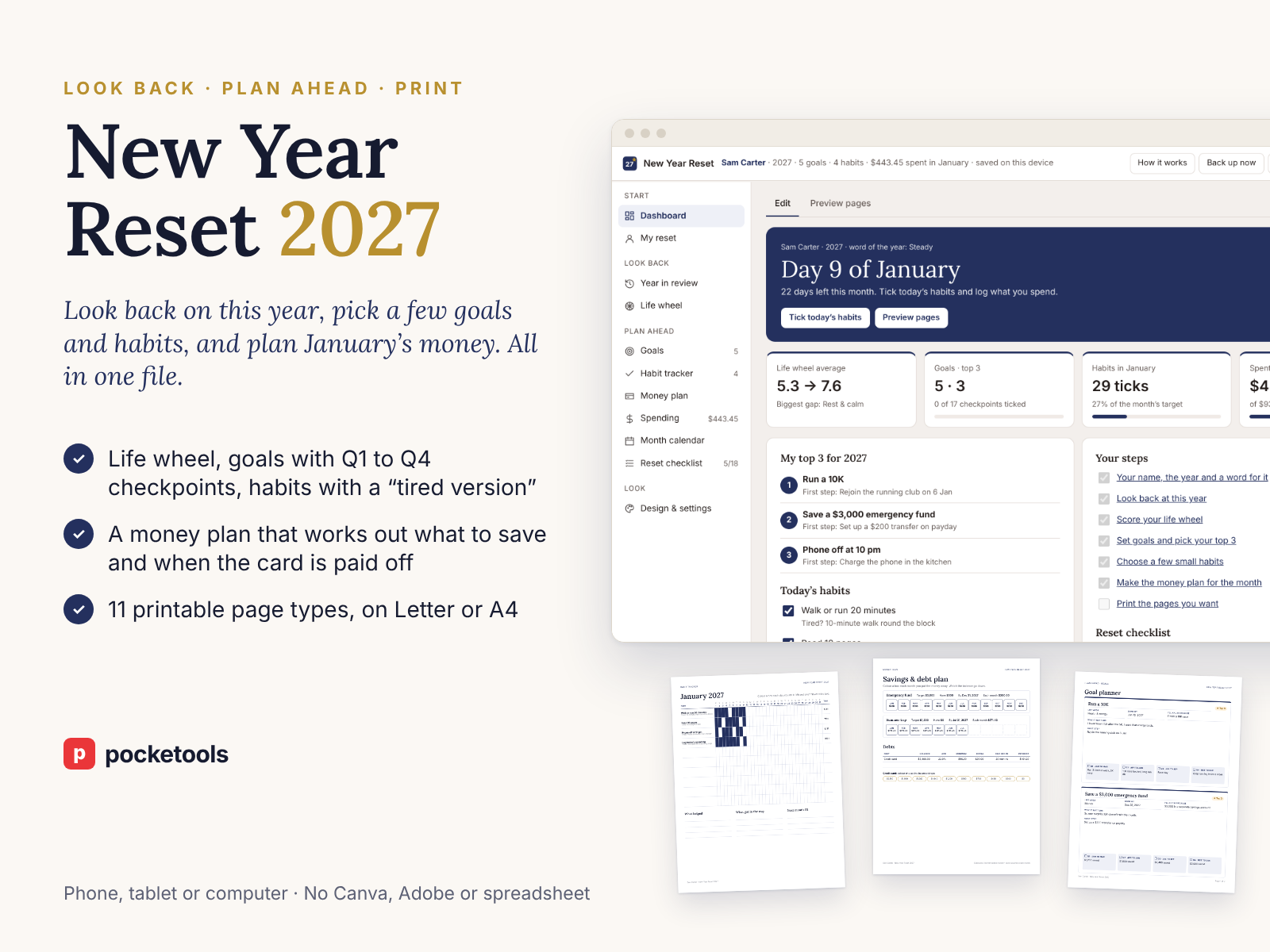
Want all eight steps in one place?
I built New Year Reset 2027 to walk you through this exact reset. The year in review, a life wheel that draws itself, goals with first steps and quarterly checkpoints, habits with a tired version, a money plan that adds itself up, a spending log and the reset checklist. Then it prints 11 page types on Letter or A4. One file, $7.95, no Canva or spreadsheet.
See New Year Reset 2027Questions people ask
When should I do a New Year reset?
Any quiet evening in the last two weeks of December works well, so January's money plan is ready before the first bills arrive. If you missed that, do it in the first week of January. The steps are the same.
How many New Year goals should I set?
Three is plenty for most people. Pick them from the biggest gaps on your life wheel and give each one a done-by date and a very first step. You can keep a longer list of ideas, but only work on your top three at once.
What is a life wheel?
A life wheel is a simple check of the main parts of your life, such as health and energy, money, work, home, family and friends, fun, growth and rest. You score each one from 1 to 10 for now and for where you want to be. The biggest gaps show where your goals should go.
How do I make a monthly money plan?
Write down everything that comes in for the month, then subtract bills, planned spending, savings and debt payments. Whatever is left still needs a job. In the worked example, $3,450 comes in, $3,044.43 is planned out and $405.57 is left to give a job.
What if I miss a day on my habit tracker?
Give every habit a tired version: the smallest thing you would still count on a bad day, like a 10-minute walk instead of a 20-minute run. Then a hard day still gets a tick, and one missed day is just one missed day. Pick up again tomorrow.
Get the next free planning tool
One email when a new free tool or guide goes up. No spam.